If you’re in the Sunnyvale area, check out the latest Sunnyvale Sun. The cover features the Sunnyvale Garden share with the smiling faces of organizer Victoria Armigo and the dedicated garden share regulars.
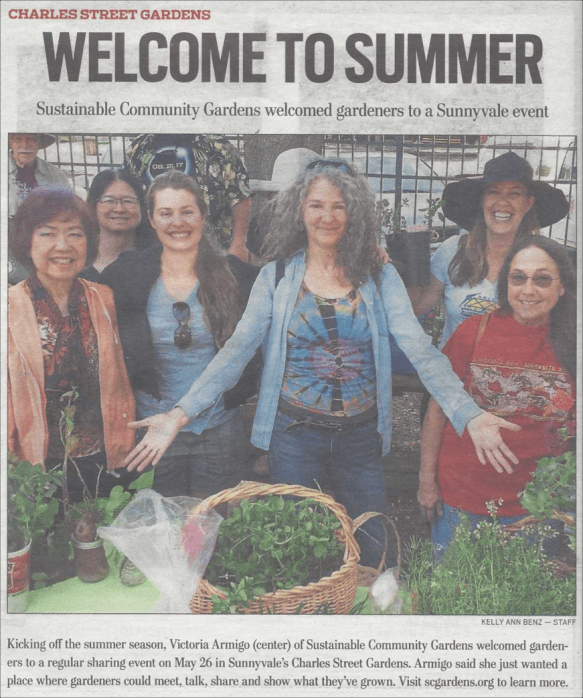
If you’re in the Sunnyvale area, check out the latest Sunnyvale Sun. The cover features the Sunnyvale Garden share with the smiling faces of organizer Victoria Armigo and the dedicated garden share regulars.
Mitchell Park Bowl
3700 East Meadow Dr
Palo Alto, CA 94303 [MAP]
Sunday, June 10, 2018
1:00 – 3:00 PM
Don’t miss the Transition Palo Alto Spring/Summer Share Faire this Sunday afternoon. We’ve got an awesome batch of skillshares lined up:
Improv Techniques with Roy
Cockadoodle Do’s and Don’ts with Victoria
Tool Care with William
Science Experiments with Hamsa
Lace making with Suzanne
Food prep with Diane
We’ll also share goods – garden and clothing, books and household items, toys and more. And we’ll share each other’s good company while building a stronger community.

“Inspired and inspiring…Not to be missed!” – Paste Magazine
We all know what a problem waste is, and previous Fourth Friday films have focused on how to reduce it. But what about all the people who work tirelessly to pick up, process, and dispose of our waste? They’re mostly invisible to us, yet they perform an essential service that most of us would never want to do.
Trash Dance introduces us to some of these people, adding an amazing and inspiring twist. Choreographer Allison Orr rides along with Austin, Texas sanitation workers on their daily routes to observe and later convince them to perform a most unlikely spectacle. On an abandoned airport runway, two dozen trash collectors and their trucks deliver — for one night only — a stunningly beautiful and moving performance, in front of an audience of thousands.
May 25 7:30-9:30pm
Fireside Room, Unitarian Universalist Church of Palo Alto, 505 E. Charleston, Palo Alto
All ages welcome! FREE, Donations appreciated.

Thanks to Zero Waste Palo Alto for providing the film and for being a great TPA partner!
This was written by my mother, who, inspired by our TPA Garden Shares, began her own in Scripps Ranch, in San Diego:
by Suhasini Jayakumar


“When the word is mad, only the mad are sane.” Akira Kurosawa
This thought came to mind as I watched ‘The Reluctant Radical’ with the Fourth Friday audience April 27. When Ken Ward, a former mainstream environmentalist realizes that business-as-usual actions aren’t waking the powers that be up to the severity of the climate threat, he starts steps in up with creative and often quixotic acts of civil disobedience. These culminated in a major action with other activists that temporarily shut down all the major oil pipelines entering the US from Canada in 2016.
The film encouraged participants to think about who is sane and who is crazy in our mad world, what kinds of actions might make a difference, and the personal and moral choices that we all face. The film also illustrated the power of social connections and mutual support among activists, as Ken evolved from a lone crusader to part of the larger group that together planned and executed the major pipeline action.
Filmmaker Ralph King introduced a second short film, ‘Arrestable’, which profiles a group of 350.org activists preparing to engage in civil disobedience to encourage banks in Seattle to divest from fossil fuels. Arrestable brings the planning and decisions about engaging in civil disobedience closer to what some of us might actually do. In the film, activists are trained on what to do and what to expect, and each decides whether to risk arrest or remain in a supporting role.
Much food for thought and action!
Transition Cafe notes from William Mutch…
In setting up Bird feeders and houses on the land I’m stewarding, I have been trying to balance having a consistent, convenient food supply with wanting the Birds to have to work for their food, so they don’t take it for granted and unlearn their foraging skills. The goal, here, is not to create domesticated, tame cultures of the formerly-wild, but to supplement their diet, replacing what my people have damaged and destroyed, until such time as the land is teaming with food for the wild folks, again. Work in progress…
Convenience, of course, is a major issue in Human culture, as well, especially in the age of amazon.com and the internet. We Humans have been grappling with our own domestication for at least as long as the rise of grocery stores and convenience stores, which offered to remove the burden of growing and preparing food, as well as making needed products and goods. How many skills did we let go, along the way? I discover new ones, constantly. How many things used to be done by hand, in the home, village, or city, that are now outsourced to slaves-Human, Machine, or otherwise?
It is hard to have a privileged class, if everyone is making things for themselves and helping each other out, and hard to motivate people to go to work to make money for themselves and widgets for others if they don’t have a life of privilege to look forward to, hopefully with enough of their life left to enjoy it. Convenience stores supply, among other things, a sense of ease and affluence which was formerly available to a very few.
Online convenience stores seem to be the next big iteration of that. Why trouble yourself to walk a few blocks, or bike into town, when you can click on a picture of something you think you want and have it appear on your doorstep soon thereafter? I have heard that there are even houses which have amazon.com-based security systems, which allow for your stuff to be dropped off inside your house by the people whose job it is to do so, eliminating even one more step in the accumulation of stuff, and you never even have to see them or talk to them. There are even, the rumors say, houses which are completely controlled by a computer system contained within the home. This must be an internet legend, of course, as surely folks see the potential issues with that. Have we not seen enough sci-fi to be concerned?
What is the cost of all of this? Is money the only metric we should be using, here? Has all of this really improved our “quality of life”? Why, or why not?
How many of you, reading this, still go into your bank and speak to the tellers behind the counter? Can you recall their names? Do you know anything about their families? How many of you prepare your own food, as opposed to having food prepared for you? What are the ingredients of your food? What are the names of the folks who got your food to your table? Are they all still alive at the time you are consuming it? Why, or why not? That thing you ordered online-who made it? What are their names? Why would you care, if it’s not Convenient to do so?
I hear, over and over, via articles, studies, and friends who experience this themselves, that many many people in this world relate to each other via their computers, and are near-phobic of personal interactions, having spent so much time at, or even growing up with, computer-mediated interactions. But then, why sacrifice the convenience of an e-mail blast for the messiness of in-person relationships? What would you learn about those around you, if you did so?
Transition Cafe notes from William Mutch
I arrived home, the other night, at the beginning of a concert. The players were just warming up, gathering, tuning their instruments, figuring out where they could play to best advantage. I was sitting in my car, in the driveway, when I felt like I should walk around the house. When I arrived at the front of the house, my headlamp picked out eyeshine, in the dark between the clothesline and the big Cork Oak. Probably seven individuals, glowing eyes bobbing and weaving as they checked me out, then they disappeared toward my neighbors’ place. I circled back around, encountering them again on the little road that runs up the hill, still checking me out. Then the concert began, Coyotes bursting into full voice.
If you’ve never experienced being near Coyotes howling in large numbers, it is something. I’d only been close to it a couple of times, before moving onto this land. My first Coyote song was scary to me, actually. I couldn’t figure out what it was, and the alien, not-Dog-ness of it had me jumpy. It didn’t help that I was one of two Humans designated to scout the Dark and figure out what on Earth that sound was… The second close experience had me right in the middle of a howling pack. I still don’t know how they felt, having me there, but I was close enough to feel the compression waves as their voices hit the air between us, and it took my breath away.
The current concert seemed to involve three packs, or three sizeable subsets of the same pack. The music swirled around, for awhile, then moved down the driveway and across the hill. I was right in the middle of it for around…awhile…which was probably shorter than it felt…
The first time I heard a Coyote, I couldn’t sleep through the night for worrying about what it might be. On a recent campout, I apparently slept right through a great chorus. I usually find it soothing, for reasons contemplated in the Transition Café archives. Not that I’m advocating for standing in the Dark, in the middle of a pack of howling omnivores…do be safe out there…
It’s funny, living in the Age of Convenience. We think nothing of traveling great distances to see things we can’t see around these parts, visit relatives who live far away, but so close via powered vehicles, order stuff from all over the globe. So much I will miss about this, when it all goes away, not least of which being the access to books, tools, and seeds I haven’t heard of. And it will, of course. I love being able to “easily” visit my sister in the North Bay, friends in the East Bay, places I love, like Mendocino, Ashland, Corvallis…things which will be so much farther away, when the cheap oil disappears. So many things we take for granted, that won’t be available anymore, at least not at a price most of us can afford. Mostly I probably miss the innocent ignorance of the early and mid-era.
The Guru and the Cat
Once upon a time, there was a certain guru. During meditation, the temple’s resident Cat would wind around amongst the meditators, meowing loudly and making it hard to concentrate on anything other than her. So, the guru ordered that the Cat be tied up outside the the meditation hall. In due course, the guru departed the physical realm for more ethereal pursuits, and the students continued to tie the Cat up outside the hall, although few had been with the temple long enough at that point to remember why. Time passed, and the Cat eventually joined the guru. So…the students procured a new Cat, who they duly tied up outside the meditation hall, while they were sitting. Centuries later, scholars would write learned treatises on the importance of having a Cat tied up outside the room in which one is meditating.
-Source unknown, but possibly fictional…
Kind of a silly story, and a trap which, in these enlightened times, none of us would ever fall into. Or…would we? How many of us have habits which we adopted so long ago that we have forgotten why we do them? How many of those habits were consciously adopted, long ago, and now are so far from consciousness that we would deny doing them if asked? How many of those habits have stories wrapped around them to justify their existence, even though they don’t make sense? How many of us make a habit of questioning those habits, when they show up, or even of seeking them out, when they don’t? For instance…how many of us refer to making an auditory duplicate of an event as “taping” it? How long has it been since that term made sense? How about the ring or wristwatch (remember wristwatches?) you no longer wear, but keep adjusting, anyway?
So, to, with Superstitions. Some make sense, sometimes called “constructive paranoia”. In other words, the behaviors do not objectively make sense, but, given the life history of the individual, not only make sense, but their life without them wouldn’t make sense. Habits like going back to check the stove, even if you know you didn’t turn it on, which drive your friends and relatives crazy, might make sense in someone who had lived in a situation where stoves were routinely left on when housemate(s!) had left for work. Others, like a dread of the number 13, might have historic or cultural roots that simply don’t make sense in the current age.
There are also funny ones, like a practice which had become Superstition, bleeding Humans with Leeches, and which, for a long time, was synonymous with barbaric medicinal practices, is now recognized to have valid medical applications. Superstitions around certain Plants being poisonous or medicinal, which turn out not to be (The Milkweed Effect).
What Superstitions are active in your life? Why do you believe them? Are they constructive, destructive, neutral? Do they make sense to you, but to nobody else? Are they cultural? Familial? Personal? Do you remember the moment you were taught one, or when you started to believe one? Is it only a Superstition if it is active in the life of someone who is not you?
Superstitions, at Red Rock Coffee, this Friday, 13 April. We often go to dinner afterwards, maybe we will this week, too.
April 27, 7:15-9:30pm NOTE TIME CHANGE
Fireside Room, Unitarian Universalist Church of Palo Alto, 505 E. Charleston, Palo Alto
All ages welcome! FREE, Donations appreciated.
April Fourth Friday will take a close look at direct climate action — how activists are putting themselves on the line and turning up the heat to fight climate change.
We’re pleased to welcome the Peninsula Peace and Justice Center and 350 Silicon Valley as co-sponsors. We’ll include some time to discuss the films and share experiences and ideas about stepping up the climate fight.

More about THE RELUCTANT RADICAL:
The film follows activist Ken Ward as he confronts his fears and puts himself in the direct path of the fossil fuel industry to combat climate change. After twenty years leading environmental organizations, Ken became increasingly alarmed by the scientific evidence of climate change and the repercussions for civilization. He now embraces direct action civil disobedience as the most effective political tool to deal with catastrophic circumstances.
The film follows Ken for a year and a half through a series of direct actions, culminating with his participation in the coordinated action that shut down all the U.S. tar sands oil pipelines on October 11, 2016. The film reveals both the personal costs and also the fulfillment that comes from following one’s moral calling- even if that means breaking the law. Ken Ward has no regrets, and his certainty leaves the audience to consider if he is out of touch with reality, or if it is the rest of society that is delusional for not acting when faced with the unsettling evidence that we are collectively destroying our world.
Director Lindsey Grayzel, co-producer Deia Schlosberg and cinematographer Carl Davis were three of four independent filmmakers to be arrested and charged with crimes for filming the activists on October 11, 2016. Their charges have been dropped, and they have joined forces to tell Ken’s story through this film. See the trailer…
Sponsored by Transition Palo Alto, the Peninsula Peace and Justice Center, 350 Silicon Valley, and the Green Sanctuary Committee of UUCPA.

