TPA at the re:Maker Fair

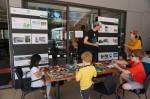
On a very hot summer day, Transition Palo Alto joined other local organizations at the Mitchell Park Community Center for the re:Maker Fair.  The Fair, sponsored by the Palo Alto Library, brought together skill shares and information tables in the spirit of a Maker Fair, but with a twist:  we all showed people how to make things out of things that might other wise have gone to waste, hence re:Maker.

Transition Palo Alto’s table was dedicated to the use of food scraps that might otherwise have been tossed.  The centerpiece of our simple table was a guessing game, where we had put different food scraps in brown paper bags.  We were amused that some people were nervous to reach into the bags! – did they think we put sharp objects in there?  The bags actually contained onion skins, potato peals, carrot tops and celery leaves, and few people guessed them all.  Having guessed the contents or not, people were then made aware of what produce we had and were asked what to do with all of them together.  The answer, of course, was to add water and to make Vegetable Broth.

We offered them some tips, which we now offer to you:

  • Do you know which vegetables and scraps to use in broth?  Jennifer’s Kitchen offers a great list of vegetables and suggested uses.  For example, onion skins add color, but if you want a nice onion-y flavor, do add a piece of the onion flesh as well.  And don’t overdo the carrot tops or you’ll make the broth too bitter.
  • The Crisper Whisperer adds yet more tips.  Potato peels, and potato of course, make a thicker broth.

We also suggested an easy method of production which had light bulbs turning on over heads:

  • Keep a container in your freezer for raw scraps and add to them as you chop your veggies.
  • Take out what scraps you need for the dish you are making, balanced for taste – but make a bigger batch than you need for that dish.
  • Put the unneeded broth in ice cube trays and freeze them.  Dump the ice cubes into a labelled container if you wish.  This way you will have small amounts of broth for flavoring side dishes, such as rice.

Of course, when you strain the broth, you will still have scraps for your compost pile.  Just fewer of them and with much of the taste and nutrition extracted for your broth.

We had a great time with the Library and hope to join them again at community events in the future.  And/or have them join us at their cousin events, our Share Faires.


May Transition Palo Alto Community Council

On Tuesday, May 22, Transition Palo Alto’s Community Council met for the second time.  Six intrepid souls met at the Prolific Oven in downtown Palo Alto to hash through the business of Transition.


We first set our mind to considering the pending election and the question set by the Steering Committee in the May TPA Newsletter:  should we endorse local propositions.  The group decided, after much soul searching, that we should not endorse propositions in the name of Transition Palo Alto.  TPA is not a membership organization, nor a registered 501(c)3 – or other- non-profit.  The assembled group thought that in order to use Transition Palo Alto’s name on an endorsement, TPA ought to have a more formal structure and a publicly defined process for endorsements, such that all members could become involved, whatever membership then entailed.  This might seem less than satisfying, but in fact it was very satisfying:  we had a group of supporters, with inclusion beyond the steering committee, come out with a well thought through position.


We did come up with our own opinions, which are those of the assembled group only.  We agreed that we supported Proposition 68 and that we opposed Proposition 70.  We decided that since none of us were residents of San Jose, we were not going to take a position on Measure B.  (Spoiler:  in yesterday’s election 68 passed, while 70 and B were both defeated.)


We talked about the City of Palo Alto’s draft Zero Waste Plan.  Most people hadn’t read it.  It is a significant document, running to about 50 pages, including charts and appendices.  Those who skimmed it were impressed by its vision, short term and long.  We decided that it was indeed something which Transition Palo Alto should comment on and kicked off a committee to make comments.  If you would like to participate, send us a message.


We ran out of time before returning to our Resource Map conversation.  One thing we’re learning is that these conversations are deep and take time.  We’ll want to put multiple items on the agenda, but order them for urgency in case we run out of time.  We’ll want to return to the Resource Map conversation soon, and if we don’t have time to finish it in the Community Council, then it may just have to kick off its own separate project.


Look to join us in Council some time.
Dolores – June Fourth Friday/Films of Vision and Hope

June 22 7:30-9:30pm 
Fireside Room, Unitarian Universalist Church of Palo Alto, 505 E. Charleston, Palo Alto
All ages welcome! FREE, Donations appreciated.

“Exuberantly inspiring… makes you want to march and dance.” — San Francisco Chronicle

dolores

What makes a consummate activist? What does it take to be someone who dedicates their life and liberty to advancing social, economic, and environmental justice?

This month we’ll take a close look at Dolores Huerta, one of the most important, yet least known, activists in American history. An equal partner in co-founding the first farm workers unions with Cesar Chavez, her enormous contributions have gone largely unrecognized. Dolores tirelessly led the fight for racial and labor justice alongside Chavez, becoming one of the most defiant feminists of the twentieth century—and she continues the fight to this day, at 87. With intimate and unprecedented access to this intensely private mother to eleven, the film reveals the raw, personal stakes involved in committing one’s life to social change. See the trailer…

Co-sponsored by Transition Palo Alto, the Green Sanctuary Committee of UUPCA, Peninsula Peace and Justice Center, and Fools Mission.