UN Association Film Festival Cafe Inequality for All – Sept 30

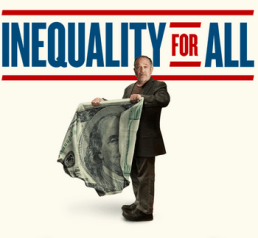
TPA is delighted to be a partner this year for the United Nations Association Film Festival. Join us on Friday, September 30 for a FREE Festival Cafe at the Los Altos Public Library. We’ll be showing “Inequality for All,” Robert Reich’s award-winning film about the widening income and wealth gap, the problems it causes, and what we need to do about it.

Until we can take a step back and understand the big picture, we can’t do anything to get ourselves out of this mess. Our democracy as we know it depends on it. I’m an educator. I love the classroom. But I also write books, appear on television and on the radio, and do everything else I can do to help people understand the economic truth. It’s my life’s work and it’s more important than ever. One of the best ways to help people understand the challenges we face, is with a movie that can grab an audience and move them to action.
–Robert Reich, Economist, UC Berkeley Professor, and former US Secretary of Labor
inequality for al big posted

The film was shown last year at the 18th UNAFF.
Click for a flyer that you can share or post.

Please register at EventBrite so we know how many people to expect.
Gather for cookies at 7pm, film starts promptly at 7:30, followed by conversation.
Friday September 30
Los Altos Public Library, 13 S. San Antonio, Los Altos

The film was first screened at the UNAFF 2105 festival (http://www.unaff.org/).

Conceived in 1998 at Stanford University by film critic and educator Jasmina Bojic in conjunction with the 50th anniversary of the signing of the Universal Declaration of Human Rights, the United Nations Association Film Festival (UNAFF) screens documentaries by international filmmakers dealing with topics such as human rights, environmental themes, women’s issues, children, refugee protection, homelessness, racism, disease control, universal education, war and peace. By bringing together filmmakers, the academic community and the general public, UNAFF offers a unique opportunity for creative exchange and education among groups and individuals often separated by geography, ethnicity and economic constraints. For more details please visit http://www.unaff.org

UNAFF2016_Banner_LOGO_FESTIVAL_849x105_v1

A Perfect Summer Day

The gentle breezes that kept knocking our signs down helped make it a perfect summer day for the Share Faire. From the world of imagination (mythmaking circle) to down-to-earth skills (scrubbing powder, eye exercises, darning, and bike repair), there was something for everyone. And lots of good stuff to share. Congrats to Peter for getting the prize cast iron skillet!

This slideshow requires JavaScript.

August Fourth Friday – “Sustainable” film and discussion

Meet Marty Travis, a seventh-generation farmer in central Illinois who watched his land and community fall victim to the pressures of big agribusiness. Determined to create a proud legacy for his son, Marty transforms his profitless wasteland and pioneers the sustainable food movement in Chicago.

Sustainable explores the economic and environmental instability of America’s food system, from the agricultural issues we face — soil loss, water depletion, climate change, pesticide use — to the community of leaders who are determined to fix it. It’s a film about the land, the people who work it, and what must be done to sustain it for future generations. See the trailer

sustainable good film 2

August 26, 7:30pm
Fireside Room, Unitarian Universalist Church of Palo Alto
505 E Charleston, Palo Alto

The Scoop on Carbon Farming

Amazing things are happening in the world of carbon sequestration. And July Fourth Friday attendees did plenty of their own knowledge sequestration while glued to their seats for John Wicks’ jam-packed talk on carbon Farming. A Marin rancher and preservationist, John co-founded the Marin Carbon Project and is a passionate evangelist for their work.

marin carbon banner

The Marin Carbon Project is noteworthy in the scope of the questions participants are exploring, the rigor of the science involved, and the effective mix of theory, field testing, and implementation. Click here for a list of some papers published by the Marin Carbon Project research teams.

Here’s a smattering of observations from John’s talk.

  • Healthy rangelands require grazing animals. The rangeland ecosystem degrades if the land is not grazed.
  • All plants sequester carbon. The question is, for how long? Some sequestered carbon is returned almost immediately to the atmosphere and some is stored up to a decade or so. But if the carbon becomes mineralized and attached to clay particles, the storage becomes effectively permanent.
  • Holistic management techniques, which involve intensive grazing of animals in a small area for short periods, are effective for promoting deeper rooted perennial grasses (vs. annual grasses), but are not effective for intermediate and long term carbon sequestration and can actually increase the amount of carbon in the atmosphere.
  • Perhaps the most remarkable observation of the talk is the finding that a single application of as little as 1/4-inch of compost can promote intermediate and long term carbon sequestration for years following the single application.
  • John spoke of many other aspects of the Marin Carbon Project work, including soil microbiology, research on composting of manures (including human waste), other sources of compostable materials, and even the efforts to lobby the California legislature and governor to support research and implementation of effective carbon sequestration techniques.

Interdependence Day on the Bay

What a glorious evening to celebrate interdependence July 4, as familiar folks and newcomers gathered behind the Acterra building in Palo Alto for a July 4th potluck picnic, enjoying delicious food and reflecting on what how we are all connected.

Later, many strolled or biked out to the baylands to enjoy a magnificent sunset, birds gliding overhead, and fireworks displays ringing the bay.  The Shoreline display started later than most, but was definitely worth it!

Thanks to all who attended and helped out, and to Acterra for providing tables, chairs, and restrooms. 🙂

This slideshow requires JavaScript.

July Fourth Friday – Gettin’ down with carbon

Come to July Fourth Friday for a taste of the latest developments in carbon farming — how responsible agriculture and land management can result in healthier food, safe fiber, renewable fuels, and healthy carbon-rich soil ecosystems.

John Wick, co-founder of the Marin Carbon Project, will share the latest in research, development, and implementation. If you attended June Fourth Friday, you’ll recall that John appeared in Evolution of Organic and shared a few comments after the film.

Many folks have expressed interest in learning more about carbon sequestration practices — what they are, what works, what doesn’t work — so we’ve invited John back for an in-depth session on the important and exciting work of of the Marin Carbon Project.

marin carbon banner

July 22, 7:30pm
Fireside Room, Unitarian Universalist Church of Palo Alto
505 E Charleston, Palo Alto


Getting Crafty in the Garden

On June 11, a group of people from Transition Palo Alto and the South Bay Permaculture Group met at Common Ground Garden to get crafty.  Half of the group sheet mulched a new section of the garden.  The other half made new signs, in anticipation of the upcoming Edible Garden Tour on July 23.  During a break, everyone got a great guided tour of the garden.  And after the work was complete, people shared a tasty, fresh, local potluck lunch together.  Look for more opportunities to work together in the garden, and in other places around Palo Alto too.


This slideshow requires JavaScript.

Organic evolution

June Fourth Friday attendees got a sneak peak at a rough cut of the new “Evolution of Organic” film, which follows the organic movement in California from the 1970s to today. The film profiles the early visionaries who integrated love for the soil, health, and culture; the entrepreneurs who expanded the scale and scope of organic; and the new visionaries of today, who are bringing the next generation into organic farming and grazing and expanding into new areas such as carbon sequestration.

Filmmaker Mark Kitchell introduced the film and led a lively discussion and feedback session afterwards.

Mark is working hard to complete the film in time for the Sundance Film Festival in January 2017, and needs funding to help complete the work. He’d greatly appreciate contributions of any amount. You can check out the crowdfunding campaign at https://www.indiegogo.com/projects/evolution-of-organic–3#/

or the film overview page at http://www.documentary.org/film/california-green-fire

Thanks to all who attended, and to Slow Food South Bay for co-sponsoring the evening.

Pix from the evening…

This slideshow requires JavaScript.