T-shirt madness

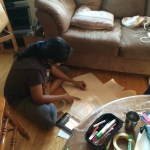
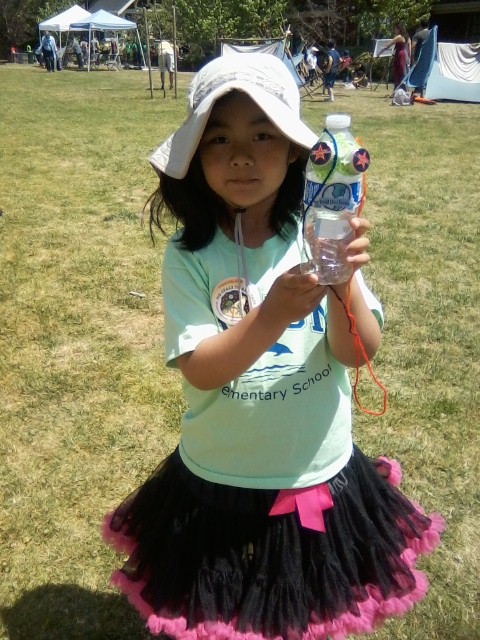
Ever wonder what to do with old T-shirts? Answer: Make a tote bag! As folks learned at June craft night, it’s easy and fun to do, and because the bags breathe, you can even use them to store veggies, etc. that you get at the Farmers Market. For an extra Transition twist, we started making TPA logos out of felt to add to the bags (or to sew onto anything else.

FullSizeRender[1]

Our Interview with Shareable Magazine

A couple of months ago, a writer for Shareable magazine approached Rani and asked us to contribute to their article on ShareFests.  Rani and I spent some time talking about their questions and then she wrote up some great responses.  Alas, when the article game out (you can read it here) it did no more than mention that Palo Alto has a Share Faire.  Well, at least we’re on the map.  But we thought that the exchange with Shareable was too good to lose, so we’re reproducing it here as a blog post for you.

Peter

==========

[?] What are some activities or events that do particularly well at your ShareFests?

Our Share Faires are held quarterly, and include goods (garden produce and tools, craft supplies, books, toys, and clothes) as well as skills, which vary each time. Classes by experts and which involve food are often popular, as well as garden-related booths, but seasonal activities (wreath-making) and new ones (shoe-making) do very well. Anything for kids attracts families – we have done crafts, storytelling, friendship bracelets, and music, among others.. We have also just tried a conversation circle with great success in an outdoor setting!

[?] In your opinion, what’s the importance of a ShareFest?

Transition Palo Alto, and the Transition movement in general, is founded on the principle that climate change and resource depletion are opportunities for a better vision of the world – one where we build community, encourage others to try things first and dive in, then understand its significance in your mind, and finally take it to heart, where it moves you. We beliyour Share Faires and other sharing events offer opportunities for people to dive in with their hands, but also deepen their involvement in the other two, through building confidence and resilience, developing and encouraging teachers, and bringing everyone along these steps to grow the movement.

[?] What are the goals for your ShareFests? What do you hope comes out of them?

Of course, we hope that sharing encourages less waste, less reliance on resources, and a stronger local economy. We hope that we are helping build a network of people who have skills and resources to support our community. However, we also hope that those who teach go deeper into understanding their roles as wisdom-keepers, and that those who attend do more than trade stuff but instead try something new, become experts and teachers themselves, and build a stronger, more integrated community that has shared its knowledge and is resilient in the face of what is coming. We have the broader goal of a vision for the future that is optimistic, interconnected, and a smooth transition to a post-carbon world.

[?] Anything you’d like to add about your events?

One issue we have had with our Share Faires is that as we become more popular, we find more people bringing items and leaving them. We have had to be careful about this sort of dumping, because it suggests an easy out – a way to release your material guilt, when what we are trying to encourage is less consumption. Instead, we are trying to focus on sharing the stories of our stuff, to make one-on-one connections, to help people find good homes for things that they are releasing from their lives.
Preparing to share

Another creative evening for craftivists! The Share Prepare team got together June 2 for sign making and related fun.

June Fourth Friday/Films of Vision and Hope – Racing to Zero

racing to zero
Racing To Zero is a quick-moving, upbeat documentary presenting new solutions to the global problem of waste. By simply substituting the word RESOURCE for the word GARBAGE, a culture can be transformed, and a new wealth of industries can emerge.
Three years ago the mayor of San Francisco pledged to achieve zero waste by 2020. Racing to Zero tracks San Francisco’s waste stream diversion tactics and presents innovative new solutions to waste. This film documents a surprising, engaging and inspiring race to zero.
Film and discussion
Friday June 26
7:00-9:00PM
505 E Charleston Rd, Palo Alto, CA
All ages welcome

Summer Share Faire June 21

On June 21st, we’ll be headed out to the Lucie Stern Patio once again for our quarterly Share Faire.

Sharing books, toys, clothes, garden produce, crafts? Check. Old, fun demos? Check. Some new and interesting ones? Check. Sunshine? Likely. Fun for the whole family? You know it. Cool people attending? Well, we have FoPAL, Neighbors helping neighbors, conversation circle, scrapophony, Fabmo, massage, and a few others, but it’ll be even cooler if you come!

If you haven’t yet had a chance to come out, check us out, join the fun, even if you’re empty-handed. If you have been before and love it, bring a friend. If you think it’s not for you, try it ou, or tell us what you’d like to see! Don’t have transportation? The VTA 35 bus gets there. Have a funny thing you’re not sure if you should bring? Ask us, or bring it anyway and take it home if no one grabs it (they just might!).

If you’d just like to slow down and enjoy the summer, start with the Share Faire. No obligation, no commitment, just being outdoors, building community, and helping make our world a little better.

Sunday, June 21st

11am to 1pm

Lucie Stern Community Center Patio (grassy area near parking lot)

1305 Middlefield Road, Palo Alto

How delicious! Where did that come from?

Where can you get a great deal on healthy ingredients that spark your culinary creativity? Answer: Your own kitchen!

Inspired by last month’s Fourth Friday showing of Just Eat It, which highlighted the staggering problem of food waste, people got creative for this month’s Shop Your Kitchen potluck. Grains from the pantry, farmers’ market leftovers, and this-and-that from the fridge all went into tasty and healthy creations.

We also got some suggestions about shopping and food storage from some short videos and discussion:

  • Shopping with a list and resisting the temptation to buy whatever looks good
  • Buying smaller quantities that you know you’ll use.
  • Adding an “Eat this first” box in the refrigerator.
  • Not storing your bananas and apples near other produce, unless you want them to ripen quickly (they emit ethylene, which hastens the ripening process).
  • Storing your lettuce first in a paper bag (the plastic keeps the lettuce from wilting, but direct contact with the plastic hastens spoilage).
  • Prepping your veggies right away when you get back from the market so they’re available to eat later with no additional prep.

May 22 Fourth Friday – Shop your kitchen potluck

We’re continuing our look at food waste with a fun “anti-food waste” evening.

Bring a potluck dish to share – with this extra twist:
Try to use as much as you can from your own kitchen. Or, ask your favorite vendors at your grocer’s, farmer’s market, or bakery for good food that might not be quite “perfect” – like day-old bread or produce with small blemishes.
  • Got a can of garbonzo beans? Make hummus!
  • Got a cabbage in the fridge? Make cole slaw!
  • Got some rice in your cupboard and some veggies in your fridge? Mix it up and get creative!
This is a “do your best” event. If you need to go out and buy something or get some new ingredients, that’s OK too. Don’t let that stop you from coming.
We’ll brainstorm about ideas to reduce waste, including anything that you’ve been doing over the past month.
PLUS we’ll show some short videos to get you inspired to take more action.

Friday May 22
7:00-9:00pm
Unitarian Universalist Church of Palo Alto Fireside Room
505 E Charleston Rd, Palo Alto, CA 

All ages welcome
Sponsored by Transition Silicon Valley, Transition Palo Alto, the Unitarian Universalist Church of Palo Alto, and Zero Waste Palo Alto.

Mary Pipher – Reviving ourselves in our capsized culture – May 30

“… [O]ur cultural and environmental crises. . . will require that most difficult of all human endeavors, facing our own despair. This involves waking from our trance of denial, facing our own pain and sorrow, accepting the world as it is, adapting and living more intentionally.” — Mary Pipher, author of The Green Boat

Transition Palo Alto is co-sponsoring a talk May 30 by Mary Pipher, national best selling author of Reviving Ophelia. She’ll be discussing her latest book, The Green Boat: Reviving Ourselves in our Capsized Culture.

A Nebraska resident, Mary Pipher found herself in deep despair about the growing evidence of climate change. A psychologist, she recognized the signs of depression — and she’ll share her story of collecting friends and neighbors to create an antidote to despair.

Mary Pipher - green boat

Saturday, May 30, 2015
7:30 – 9:00 pm
Palo Alto Unitarian Universalist Church
505 Charleston Road, Palo Alto

Go to http://buff.ly/1GyD3bL to reserve your seat for $10. Donations will be accepted at the door on May 30; no one will be turned away for lack of funds as long as seats are available.

Mary Pipher’s talk is the kick-off to an “All City Read,” co-sponsored by the City of Palo Alto Library. Pick up a copy of The Green Boat from the Accounts desk at any Palo Alto City Library branch. No need to check it out; please read and pass it along to a friend or return it to the Library. Then join with others for one of four discussion groups:

Thurs. June 4, 6:30 pm – Mitchell Park Library, 3700 Middlefield Road, PA
Sat. June 6, 4 pm – Downtown Library, 270 Forest Avenue, PA
Fri. June 12, 10:30 am – College Terrace Library, 2300 Wellesley Street, PA
Mon June 15, 6:30 pm – Rinconada Library (formerly Main Library), 1213 Newell Road, Palo Alto

May Fete Fair Fun

Marching bands, walking bald eagles, aliens, children on parade…and Transition Palo Alto! On Saturday, May 2nd, we joined hundreds in Palo Alto as part of the May Fete Fair, which follows the (93rd) annual Children’s Parade. This year’s theme was No Space to Alienate – be Unique, be Free, be yOu (UFO), so of course there were aliens and spaceships everywhere!

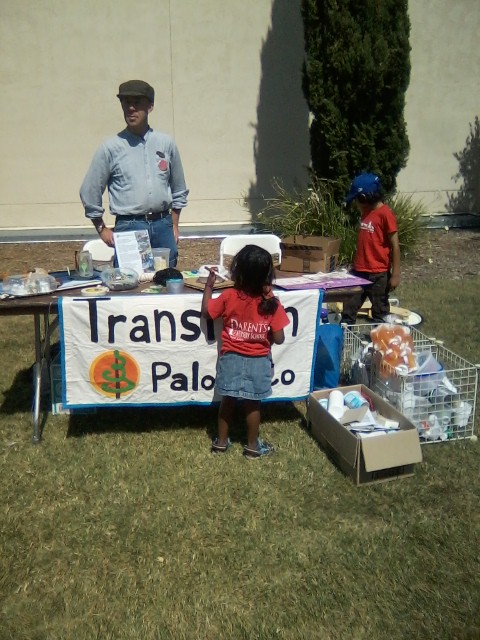
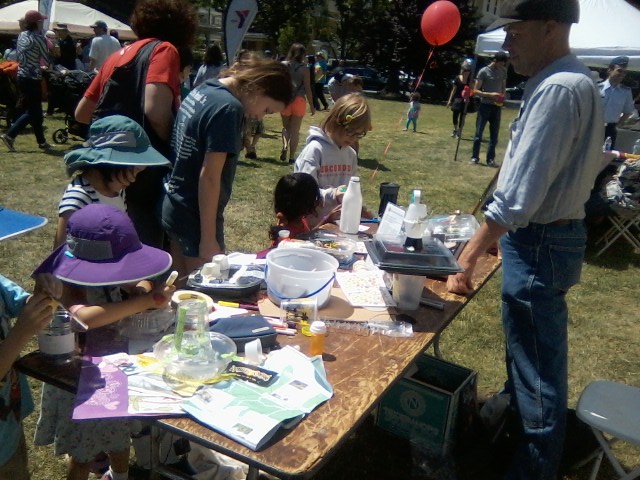
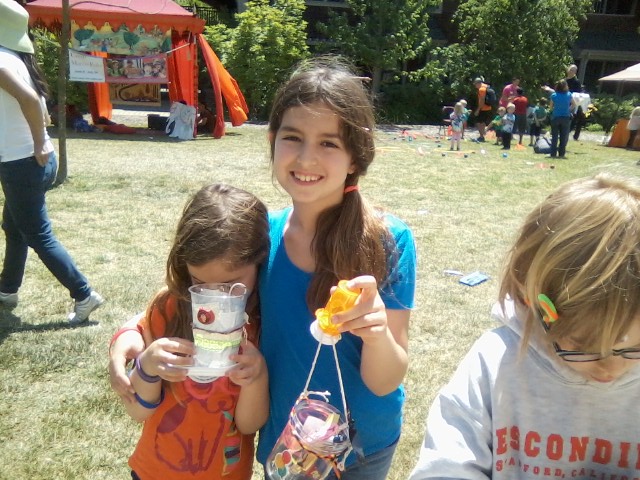
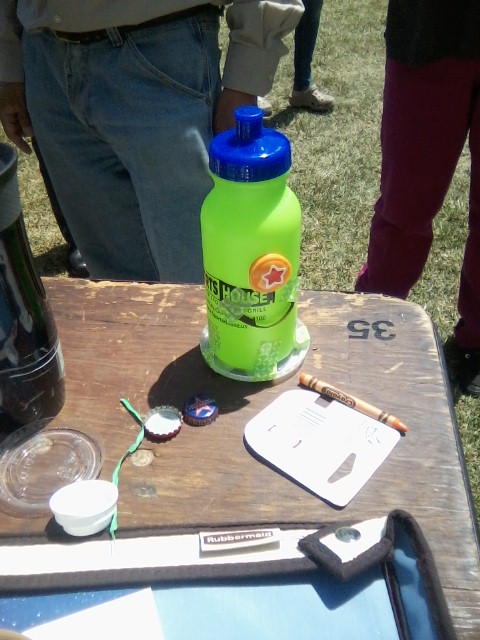
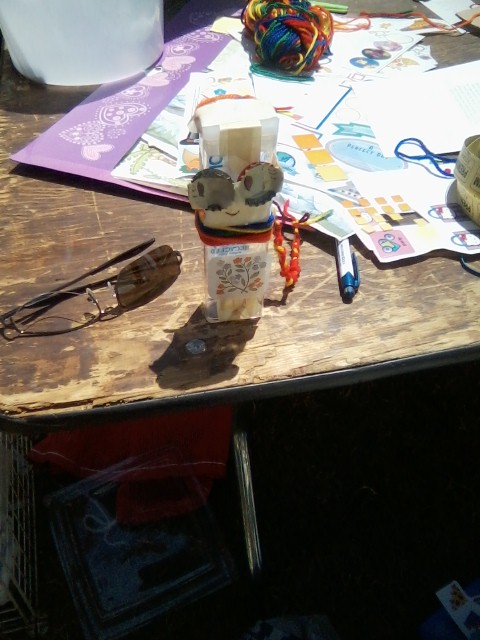
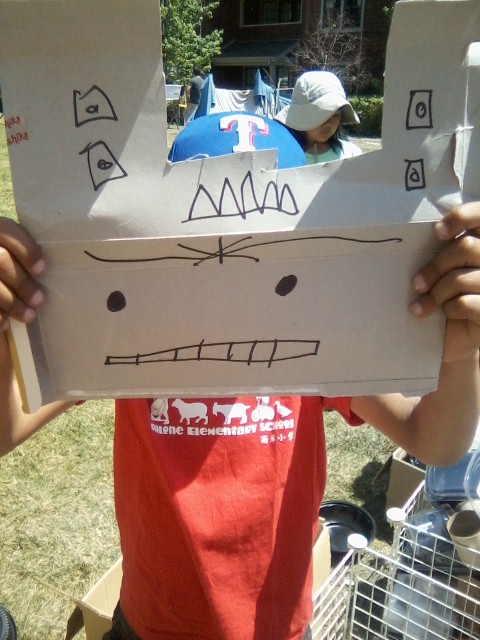
After dodging closed streets, I and my kids unloaded boxes of recycled to-go containers and shiny plastic doodads rescued from the landfill, gathered generously by Trina. We marched (and rode a bike) in the parade with their respective schools, and we ended up at a table on the grass at the parade, where William Mutch was staffing a table where children were making UFOs and aliens out of those recyclables. We had a display of aliens and spaceships made at the Craft Night and artfully arranged by Trina. Using those as examples (or ignoring them entirely!), children braided yarn, stuck on tape, stuffed prescription bottles and ice cream containers, stuck stickers and bottle caps, and created amazing worlds of their own imagination. A few of the creatures and vehicles below. We were calling it Junkology (thanks, Elliot!) and having a blast of it.

Thanks to William Mutch, Roy Kornbluh, Peter Ruddock, Vanessa Warheit and Trina Lynn-Wilson for making this happen, and to all the children and parents for making this event out of this world!

Image05022015111018  Image05022015114653Image05022015122100 Image05022015124844 Image05022015125244 Image05022015125853 Image05022015125935

April Fourth Friday – The incredible story of food waste

Folks jammed the Fireside Room for the West Coast community premiere of Just Eat It, a funny, entertaining, and jaw dropping look at the staggering problem of food waste.  40 percent of produced food is wasted throughout the production and delivery cycle, from the farm and factory to people’s homes. Not only does that mean that food isn’t getting to people in need, but it’s also an obscene waste of energy and water.

What can we do about the problem? After the film, Maybo AuYeung from Zero Waste Palo Alto answered questions about what the city is doing about the waste problem, and attendees shared stories and strategies: changing shopping strategies, pressuring local grocers to change their practices, gleaning excess produce to give to those in need, and even creative dumpster diving.