Next Craft swap

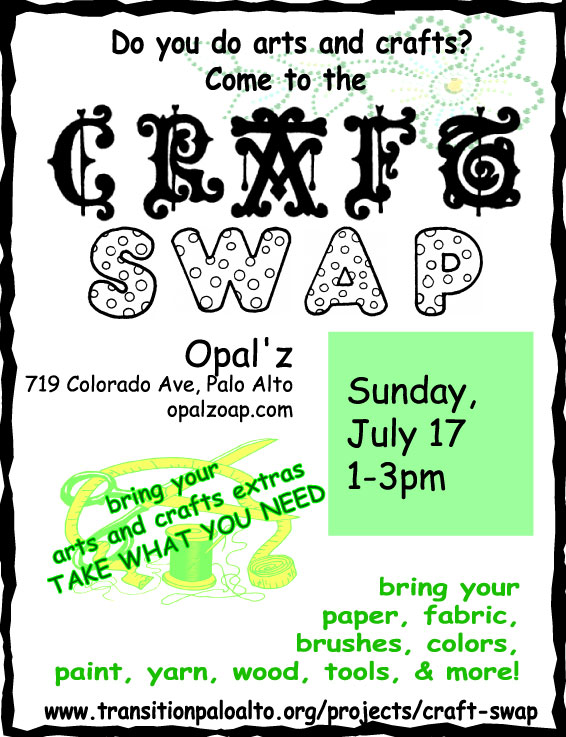
Our third craft swap will be on Sunday, July 17 1-3pm at Opalz in Midtown Palo Alto. Please rsvp to rani: bacraftswap at gmail dot com if you’ll be coming!

Click here for more info on the craft swap, and information about previous swaps. Please share the information with crafters, artists, teachers, families, and others who may have or need supplies. Feel free to post the flyer:

Craft swap 3

Eating in the year 2043

Today’s post is from a guest blogger, Maria Mesa of cookorgasmic.com—a blog about food-related activities, especially enjoying food.  She is an active member of Transition Palo Alto and enjoys reading comments and suggestions from readers.

The National Geographic of January 2011 published an article that estimates a total of 9 billion people for the year 2043. This article got me thinking about the magnitude of the challenge that we will be facing very soon: the need to feed a global population of nine billion with a diminishing supply of cheap fuels available to fertilize, plow, and irrigate fields and to harvest and transport crops. Optimistic estimates of peak oil production forecast the global decline will begin by 2020 or later, and assume major investments in alternatives will occur before a crisis, without requiring major changes in the lifestyle of heavily oil-consuming nations. Pessimistic predictions of future oil production believe that a proactive mitigation may no longer be an option; a global depression is predicted, perhaps even initiating a chain reaction of the various feedback mechanisms in the global market that might stimulate a collapse of global industrial civilization, potentially leading to large population declines within a short period.

Almost two centuries ago Jean Anthelme Brillat-Savarin stated that the destiny of nations depends on the manner in which they are fed. The removal of fossil fuels from the food system is inevitable. Only the amount of time available for the transition process, and the strategies for pursuing it should be matters for debate. The end of the cheap fossil fuel era must be reflected in a change of diet and consumption patterns among the general population, with a preference for food that is locally grown, that is in season, and that is less processed. A shift away from energy-intensive, meat centered diets should be encouraged.

Rob Hopkins, in The Transition Handbook: from oil dependency to local resilience, does not give an exact set of solutions to face peak oil production and climate change, since he believes that what works in one place will not necessarily work in other places; however, he does believe that localizing is the broad answer: stronger local economies, increased local democracy, strengthened local food culture and a more local energy provision. After reading Hopkins’ handbook, I decided to try to imagine how people would eat in the future, and I decided to pick the year when the world’s population would include 2 billion more people and when even the most optimistic estimates of peak oil production predict major changes in the lifestyle of heavily oil-consuming nations.

For the purpose of this exercise I will imagine the life of a fictional lawyer in the year 2043, John Doe, who lives and works in Silicon Valley. When John Doe is not in the courts dealing with the usual family and criminal litigation, he is occupied growing food at the town’s farm. After the U.S. government finally rationed energy, when the oil prices became prohibitive for fossil-fuel-based agriculture, Silicon Valley organized into small towns or no more than 5,000 people. These local communities rely on biointensiveagriculture, and most include industrial plants and high-tech enterprises. Food became a central activity in the lives of people since the cost of food started to use up at least 50% of the typical budget, and people’s only alternative became to participate directly in producing and processing food in the town’s many new farms. Even lawyers and other specialists could no longer command unusually large incomes, so they too worked in food production.

John Doe works on a local farm for two hours before having breakfast in the communal dining hall at 8 AM. Parents eat with their children in the communal dining halls of their children’s schools. The food offered in these dining halls is mostly produced in the town’s farms, with a small portion coming from each school’s edible garden. Children work in school kitchens, where they experience culture, history, language, ecology, and mathematics through the preparation of food.

John Doe goes back to the farm from 9 AM to 11 AM. John has discovered the pleasures of working with the land, and he is experiencing the satisfaction of harvesting his food and seeing it end up in his plate, he is also rediscovering the superior taste of local and organic produce. Lunch is served (also in the communal dining hall) at 11 AM. After lunch John Doe litigates in the town’s courthouse until late evening, and then John returns to his house and participates in the preparation of food with the people that live in his lot.

The menu is seasonal, mostly based in grains, vegetables and fruits, but lamb, chickens, rabbits, and other small farm animals that feed mostly from grasslands are occasionally part of the diet as well as the fish caught in the Pacific Ocean. Main courses in the communal dining hall menu include grilled sardines, chicken al Mattone, fried rabbit, braised grass-fed goat, fish and shellfish in broth, spit-roasted pork loin, sautéed black cod, spit-roasted guinea hen, spot prawns, rack and loin of lamb.

The dramatic changes in the food landscape in America triggered the most remarkable improvements in health in the United States, in which diet-related diseases had been the biggest killer, two-thirds of Americans were overweight or obese, and children had a shorter life span then their own parents. Americans came out of the limbo of gastronomy where they were, and in the year 2043 they know how food arrives at their table. They understand that food is almost as important as language; it provides a sense of identity to a nation even more so than language. The alphabet for food is the produce, the grammar is the recipes, the syntax is the menu and the rhetoric is the conviviality. The way Americans will eat in the year 2043 will depend on the willingness of the Americans of the year 2011 to learn food’s language or to stay in the limbo of gastronomy.
Local Garden Share

Neighbors Sharing Food/Flowers/Herbs from their Gardens

Sunday, May 22, 11 AM – Noon  FREE !

Common Ground Garden Supply & Education Center
559 College Avenue
Palo Alto, CA 94306

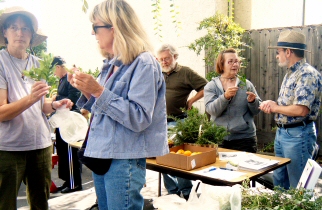
The first local Garden Swap was held August 21,2010, with people coming together to share produce, chat and get to know one another. Four other events followed where home gardeners met for a free exchange of garden bounty. Here is one guest’s rave review: “What a great event, like a free farmers’ market – grapes and raspberries and oranges and two types of apples, sage and oregano and rosemary and thyme, sorrel and a plethora of tomatoes, seeds to save and plant, and some beautiful flowers. Thank you!” – Rani

Sunday, May 22 will be the kick off event for the 2011 season.

Join us to share garden bounty. Bring what you have to share; take home something you don t.  Think of it as a free backyard farmers market.  (And if you can’t find what you’re looking for, the California Ave. Farmer’s Market is happening concurrently.)

Bring your homegrown fruit, vegetables, eggs, herbs, honey, flowers, seeds, & plant seedlings!

Throughout the Bay Area, neighbors are coming together for sharing locally grown, fresh produce. Our Palo Alto sharing event is supported by a coalition of community ecological organizations and neighborhood groups including: Acterra, Barron Park Green Team, Barron Park Garden Network, Barron Park Assn., Common Ground Garden Supply & Education Center, City of Palo Alto Community Gardens, Slow Food South Bay, and Transition Palo Alto.

“Profiles of Vision and Hope” blog

Rani created a blog, “Profiles of Vision and Hope“, to allow local people to write about what they have done to lower carbon footprints or to build local resilience.  Let’s share how we are making the transition to an energy-lean, but more connected and less stressful, healthier and happier way of life!

“This is a place where you, residents of Palo Alto and surrounding communities, can tell your stories – how you came to learn about peak oil, climate change, or Transition, how these have affected you in your daily life, the struggles you are undergoing or have overcome, or your visions for the future.”

Rani will add contributors and manage submissions. As it grows, I expect she will add categories and possibly other features—send ideas her way (using the form on the blog’s home page)!

Happiness Circle April 26 (Conversation/Community group)

One of Transition PA’s regular workshop groups is the Conversation, Community and Calling which meets every other Tuesday at World Centric from 6:45 – 8:45.

Here are our upcoming events and minutes to give you an idea of what we do. Admission is open and newcomers are welcome.


April 26 – Happiness Circles

Cecile Andrews, who developed the idea of Simplicity Circles, will give a preview of her new project: Happiness Circles. (It turns out that Happiness is a hot topic these days! See Happiness movement hits the UK

The Community Happiness Circle:
Discover how a small group of committed citizens can come together to support each other in the pursuit of happiness and social change — pursuing both personal and social wellbeing. Learn about the new research on happiness and change. Explore the three keys to happiness: connection, calling, and celebration: how to form a caring culture by building community, discovering our particular passion, and living with joie de vivre. The community happiness circle is part of a long tradition of people coming together to change their own lives and create a culture concerned about the common good.

May 10 – Bullying

William led a session on April 12, which we will be continuing with lots of discussion on May 10. We are covering:

* Interpersonal dynamics
* Latest research
* In the workplace
* Problems for activists
* Tactics
* Solutions

Possible Topics for the Future

How to use Facebook
For friendship, networking and activism

How to work with corporations – promises and pitfalls
Greenwashing and Class-B corporations
http://www.bcorporation.net/
http://en.wikipedia.org/wiki/Greenwashing

What Inspired Us

We talked about bringing something creative that inspires us in our activism/engagement. In the April 12 meeting, Eitan, Barbara and Bart brought something. We may make this a regular part of our meetings. Here are the contributions for last week:

Eitan’s picks
Lova and Anarchy by Lina Wertmüller
a movie set in Mussolini’s Italy
http://www.imdb.com/title/tt0070061/

The entire film is online

What is Life?
by physicist Erwin Schrödinger.
http://en.wikipedia.org/wiki/What_Is_Life%3F

Bart’s picks

Vienen Los Pajaros (music Mikis Theodorakis, text Pablo Neruda)
Greek rhythms, surrealist imagery, a myth for Latin America

The Spanish and English for “The Coming of the Birds” appears in
https://files.nyu.edu/emf202/public/mt/CantoGeneralEN.html .

Barbara’s picks

Three Cups of Tea and the sequel, Stones Into Schools:
two books by Greg Mortenson
http://en.wikipedia.org/wiki/Greg_Mortenson

Oedipus Rex by Sophocles
http://en.wikipedia.org/wiki/Oedipus_the_King

For more schedule information, see the Transition Palo Alto calendar:
http://groups.yahoo.com/group/transitionpaloalto/cal///group/transitionpaloalto/?v=2&t=1302249600

Rethinking Cities: Film and Discussion Series

A look at how sprawl replaced traditional neighborhoods and what can be done to bring back community and sustainability to our cities and towns.  Group discussion follows (each evening).
 
Films start at 7 PM (Friday evenings), Laurel Room,  Sunnyvale Community Center, 550 East Remington.  Doors open at 6:45.  FREE. 

May 6–Save Our Land,  Save Our Towns. (One hour) Small town newsman Tom Hylton explores why America’s towns have declined and what we can do to revive them.  “Development and zoning issues normally make the eyes glaze…  Tom Hylton makes them downright fascinating.” Philadelphia Daily News

May  13–Creating Places We Want to Live

  • Portland: A Sense of Place. (Design e2) (30 minutes) 2008 Thanks to a  progressive public transportation portfolio that includes train, streetcar, bus and aerial tram, Portland has become one of the most livable cities in the US.
  • Community by Design. (26  minutes) 1997 Learn about the key role that design plays in building community, from some leading progressive thinkers on the subject.

May 20–Welcoming Pedestrians and Cyclists to the City (selected from Streetfilms)

  • Copenhagen’s Car-Free Streets and Slow Speed Zones. (5:08)  2010
  • An Alfresco Talk with Jan Gehl. (9:48) 2008
  • Moving Beyond the Automobile:  Bicycling.  (3:36) 2011
  • Ciclovia Bogota.   (9:41) 2007
  • San Jose Hosts Inaugural Via Velo.  (4:25) 2010

June 3–Developing Sustainable Transportation:  Bus Rapid Transit (BRT) and Bicycle Infrastructure

  • Curitiba’s BRT Inspired BRT Around the World.  (Streetfilms)  (8:03) 2009
  • Guangzhou, China’s Winning the Future with BRT. (Streetfilms) (5:18)  2011
  • BRT:  LA’s Orange Line:  Bus Rapid Transit (Plus Bike Path). (Streetfilms) (4:56) 2009
  • Bike Sharing Paris:  Velo Liberte.  (Design e2) (30 minutes) 2008 The public-private Velib bike initiative encourages Parisians to forgo cars for bikes and public transportation, fostering a unique popular culture in the city.
  • Cycling Copenhagen Through North American Eyes. (Streetfilms) (10:45) 2010

This film and discussion series is co-sponsored by Sunnyvale Cool, Transition Silicon Valley, and Sierra Club (Loma Prieta Chapter).  Made possible in part by a grant from the Silicon Valley Community Foundation.

Take the Drive Less Challenge! Get your bike a free tune-up.

Take the 2011 Drive Less Challenge! April 22 – May 5th, 2011

The Drive Less Challenge is a fun way to try alternatives to driving your car to work, school, shopping and other local places. Walking, biking and taking transit instead of driving are great ways to live healthy and reduce car traffic, the largest source of CO2 emissions in the Bay Area!

Sign up at drivelesschallenge.com to use a game-like trip log, share your stories, and to join the Transition Palo Alto group. You can join and also form your own additional groups – friends, co-workers, neighbors, and others – to compete for fun and for prize gift certificates from local shops.

The Drive Less Challenge is an innovative, grassroots movement that encourages people to use alternatives to solo driving as a way to live healthier, do more local shopping, and reduce car traffic and CO2 emissions. To volunteer or sponsor please contact drivelesschallenge at gmail dot com

See you out there walking, biking, on the bus or train!

If you do any biking (or want to), get your bike a free tune-up at Mike’s Bikes! More info …

Free Maintenance Clinics

Mike’s Bikes is here to teach you how to fix, maintain, and improve your bike – every Wednesday night, for free! All you need to bring is your bike and your questions. Our expert mechanics will provide you with hands-on instruction on just about anything you want to know.

Wednesdays at 6pm
Mike’s Bikes
3001 El Camino Real @ Olive Ave.

Learning how to fix your own bike will not only save you money, but will also empower you to tune and troubleshoot your bike out on the road or trail.

Every Wednesday night, we’ll provide participant-determined, hands-on instruction on common maintenance topics such as:

  • Fix a flat
  • Tune your shifters, derailleurs, and brakes
  • Fix a broken chain
  • Install accessories
  • Adjust your bike to better fit your body
  • Swap out worn components

And more (participant-determined)

Building Backyard Gardens

On Saturday, May 14th, volunteers and community members in East Palo Alto will come together to deliver and install up to ten backyard gardens for eager beginning gardeners. Many of these gardeners have completed a twelve week course of cooking, nutrition, and gardening with Collective Roots, and are excited to launch new lifestyles full of healthier, more environmentally sustainable, home-grown food.

Come help install raised beds and plant spring gardens to make these new lifestyles a reality!

To register for this event, or if you have any questions, please e-mail:  nicole at collectiveroots dot org.