Newsletter – December 30, 2010

NEWSLETTER – December 30, 2010
CONTENTS

New Years Eve party
Upcoming Events
No Impact Experiment
Ideas for Community Building in the New Year

———-
NEW YEARS EVE –

World Centric has invited us to a New Years Eve event, starting at 7 pm
Transition members should have received an invite (see emailed newsletter)

———-
UPCOMING EVENTS –
* Jan 4 – Free workshop 7-9 pm at World Centric with Cecile Andrews
“Conversation, Community, and Calling” https://transitionpaloalto.org/2010/12/10/group_workshops/
* Low impact experiment (January) – see note from David Coale below
* New film series “Making Cities Livable” (tentatively scheduled to start in January)
* New low carbon diet class (scheduled for January) – contact Annette Isaacson
* New Transition book group starting in late January – contact Emily Rosen, Paul Heft or William Mutch

———-
NO IMPACT EXPERIMENT

Here is reminder about the No Impact Experiment I and other folks will be involved in starting Jan 2. Please join me in exploring ways to lessen our impact. This is a project by Transition Palo Alto. See: https://transitionpaloalto.org/2010/12/07/the-no-impact-experiment/ for more information or follow the links below.
– David Coale (Transition Palo Alto)

Join me, Transition Palo Alto, and many others in The No Impact Experiment! It’s a one-week exploration of how to reduce our negative impacts on our environment, beginning January 2nd (in partnership with YES! Magazine (http://www.yesmagazine.org/) and the No Impact Project (http://noimpactproject.org/experiment/).

We’ll learn a few things about living a happier life, and maybe change a few habits in the process.

This is not a test. There is no scoring, there are no judgments. It’s a chance to experiment with small changes in our lives, as part of the big cultural shift we are undertaking to live in balance on our planet. They supply information and support for each day of the week during your exploration experiment. We might learn whether less environmental degradation brings with it more happiness! If you already do a lot to lessen your impact, great! Consider this a tune-up.

Try it! Register on the No Impact Project website. http://noimpactproject.org/experiment/

(Visit How It Works to preview step-by-step instructions, http://noimpactproject.org/experiment/how-it-works/
or Reflections on a one-week carbon cleanse to read someone else’s experience.) http://eartheasy.com/blog/2010/01/reflections-on-a-one-week-carbon-cleanse/

Also think about sending this around to your friends and neighbors as it is fun to do as a group.

David Coale / Transition Palo Alto.

**********************
NOTES FROM POTLUCK
Ideas for Community Building in the New Year
(courtesy of Barbara Weinstein)

* More swaps – such as gardens, seedlings. Note that Acterra is planning a conference on sharing…
* Continuation of Cecile Andrews’ workshops on conversation – perhaps continue after she completes the initial sessions Jan 4.
* New book and study groups (science of climate change, any other topics..)
* Reskilling work group (possible workshop/conference this spring)
* Connecting with Stanford staff and students – for this, it would be best to have activities on campus, or in the case of staff, close to transit lines
* Workshops on bike repair
* Knitting groups
* Book exchange
* More social get-togethers

Things to work out…

* Arranging for space for meetings, films (since we won’t be able to meet at World Centric after March).
o Talking to KEEP in Palo Alto about partnering with them to get some city space (such as Lucy Stern) for free
o Local libraries (Palo Alto, Cupertino, Los Altos, Mountain View
o Peninsula Conservation Center (where we held the first film series)
o Stanford rooms (need a faculty or staff sponsor to get for free?)
* How best to help people brainstorm ideas for activities and get together to make them happen.
o Use Facebook?
o Try to use the Transition web site to help connect people who want to work with others on ideas for activities
* Consolidating email lists

– Bart Anderson (temporary editor)
Free group workshops: “Conversation, Community, and Calling” Dec 14, 21 and Jan 4

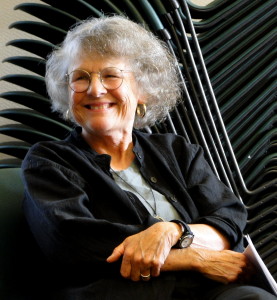
We’ll be following up our Conversation and Community group with three sessions, led by Cecile Andrews of Transition Palo Alto

Admission is open and free.

Conversation, Community, and Calling
Tuesdays, Dec 14th, 21st, and Jan 4th
7-9
World Centric, 2121 Staunton Court
Palo Alto, CA 94306
Free

Based on the practice of good, effective conversation, in this three session series we’ll examine how you can use conversation and community to advance your vision of cultural change. Among other things, we’ll explore Jeremy Rifkin’s idea of the empathic civilization, the new gross national happiness movement, and ongoing efforts for wealth equality.

The presenter is Cecile Andrews, author of Circle of Simplicity, Slow is Beautiful, and Less is More

Sponsored by Transition Palo Alto

This is a follow-up to last month’s workshop Developing Conversation and Community Building Skills

The No Impact Experiment

Join Transition Palo Alto and many others in The No Impact Experiment!  It’s a one-week exploration of how to reduce our negative impacts on our environment, beginning January 2nd (in partnership with YES! Magazine).

We’ll learn a few things about living a happier life, and maybe change a few habits in the bargain.

This is not a test.  There is no scoring, there are no judgments.  It’s a chance to experiment with small changes in our lives, as part of the big cultural shift we are undertaking to live in balance on our planet.  We might learn whether less environmental degradation brings with it more happiness!

Try it!  Register on the No Impact Project website.  (Visit How It Works to preview step-by-step instructions, or Reflections on a one-week carbon cleanse to read someone else’s experience, or read the How-To Manual.)

You’re then welcome to use the Leave a Comment link on this blog post to share your experience during the experiment.  (Suggestion:  Bookmark this post as a favorite so you can return easily in the future.)

No Impact Project logo

Holiday garden, cookie and craft exchange – Dec 11

Saturday December 11th 2:00 – 3:30pm FREE !
World Centric Community Space
2121 Staunton Court, Palo Alto

Join us for the holiday community free exchange of garden bounty & Holiday creations. Bring Holiday cookies and decorations to swap & your homegrown fruit, vegetables, eggs, herbs, honey, flowers, and holiday greenery to trade!
 
Throughout the Bay Area, neighbors are coming together for swapping and sharing locally grown, fresh produce. Our first Garden Swap was held August 21, with people coming together to share produce, chat and get to know one another. Four other events followed where home gardeners met for a free exchange of garden bounty. Here is one guest’s rave review: 

“What a great event, like a free farmers’ market – grapes and raspberries and oranges and two types of apples, sage and oregano and rosemary and thyme, sorrel and a plethora of tomatoes, seeds to save and plant, and some beautiful flowers. Thank you!” – Rani

Saturday, December 11, we will expand the concept to exchange homemade holiday creations, as well as all great late fall produce, such as persimmons, lemons, and oranges.  Bring cookies and other sweets, crafts, decorations, & greenery to exchange for the handmade goodies of your neighbors.  Expecting that some of the cookies will be eaten on site, we will provide apple cider to quench your thirst.

Come for the food, come for the community.  Hope to see you there.

Our Palo Alto exchange is supported by a coalition of community ecological organizations and neighborhood groups including: Acterra, Barron Park Green Team, Barron Park Garden Network, Barron Park Assn, Common Ground, Palo Alto Community Gardens, Slow Food South Bay, Transition Palo Alto & World Centric.

You can print out this PDF of the event announcement to hand out to friends and co-workers.

(Information courtesy of Jan Butts)

Join us to read The Transition Handbook

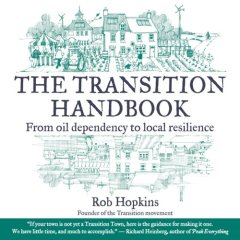
The Transition HandbookTransition Palo Alto is sponsoring our fourth book discussion group.  Join us to read The Transition Handbook: From oil dependency to local resilience by Rob Hopkins (founder of the Transition Movement). 

We will meet weekly for six weeks to learn about Transition and consider personal and community responses to the threats of peak oil and climate change.  The groups so far have inspired a vital interactive hands-on community of resourceful and talented people.

Our first meeting will be Thursday, January 20, 2011, from 7 to 9 PM.  If you are interested, please let us know by sending an e-mail message to Emily Rosen (mlerosen at jps dot net), and she will send out the details.

More information about the book is below.  Hope you can join us!

Description of  The Transition Handbook:  http://transitionculture.org/shop/the-transition-handbook/

Another useful, short introduction by Transition US:  http://www.transitionus.org/transition-101

Online version of The Transition Handbook (PDF):  http://transitionus.org/sites/default/files/TransitionHandbook_freeeditVersion.pdf

An outline of The Transition Handbook:  https://transitionpaloalto.org/2010/03/21/outline-of-the-transition-handbook-with-notes/

We will use a study guide (developed by Transition Seattle):  http://transitionseattle.com/resources/discussion/

Craft swap a success

Our first attempt at a craft swap can likely be called a success!

We met at A Work of Heart, a beautiful, inspiring studio with drawings of fashion models and handmade paper dolls on the walls, pretty little supplies and trinkets for sale, and a room full of empty tables. They weren’t empty for long. Tamara brought hand-drawn signs made by her school typography students, labeling everything from paint to scrapbooking. The tables were soon filled with bits and baubles, fabric and yarn and stickers, and about ten of us loitered, shopping for free.

More than just the shopping, we traded craft ideas and tips, learned about upcoming events, and found local resources. We also found out about everyone’s hidden talents and unique skills.

Everyone had delightful supplies to donate: cards, scrapbook items and papers, stickers (a hit with the kids), beads, craft kits, magazines and books, tons of fabric (lovely brocade that walked away fast) and yarn, oil paints, gift wrap and bags, ribbon, markers, stamps, miscellaneous stuff (including pasta makers, trays and cork boards!) and so much more. We distributed about half the items, the rest awaiting the next swap (keep your eyes open for an announcement in February or March next year!).

Thanks to all for their support and helping make this exchange happen.

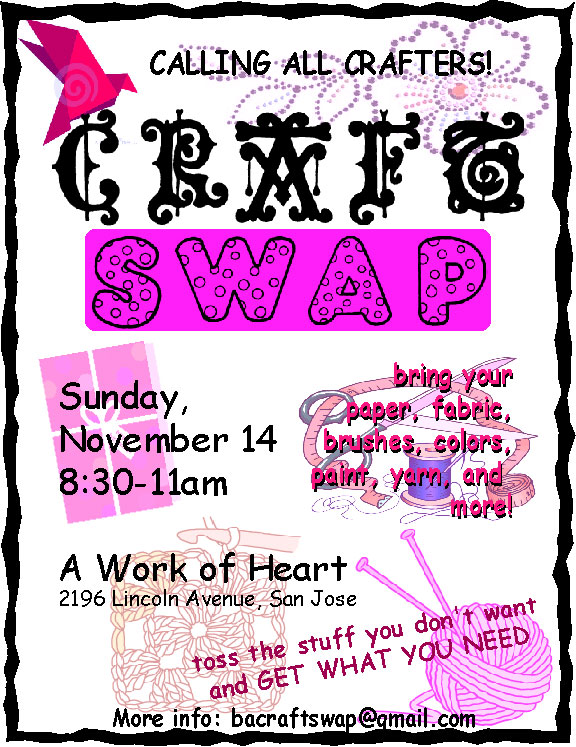
CRAFT SWAP

Got some extra crayons lying around? Are you a closet knitter with a room full of yarn? Scrapbooking, paper-making, jewelry-making, drawing, painting, sculpting, and more – whatever your craft is, you need supplies. Why not trade for them?

Come meet other crafters, share your extras and take home some goodies at our first CRAFT SWAP!

When: Sunday, November 14, 2010. 8:30-11am

Where: A Work of Heart, 2196 Lincoln Avenue, San Jose, CA

What to bring: Arts and crafts supplies (no one empty-handed will be turned away), and an extra bag or basket to carry what you want.

You’ll bring in what you have, put it on the appropriate table, and go shopping for free.

Come join the fun! Questions? Email rani at bacraftswap at gmail dot com

Developing Conversation and Community Building Skills – Workshop November 16

Developing Conversation and Community Building Skills
Workshop November 16

Cecile Andrews, Simplicity author/lecturer will lead a workshop showing ways to build community and examining the essential ingredients of good conversation.

Tuesday November 16 7:00 – 9:00 pm
World Centric, 2121 Staunton Court, Palo Alto
(behind JJ&F, just off El Camino Real, in College Terrace)

Free

Saving the planet means creating a caring culture. Social ties are central to health, happiness, and civic life. Yet our frantic, distracted culture makes it difficult to maintain and deepen social connections. Trust and civil discourse are in decline.

  • Have better conversations
  • Improve your satisfaction with the communities you’re in
  • Be more effective in engaging people
  • Ideal for business, non-profits, activism
  • Follow-up group for those interested

Led by Cecile Andrews, author of Less is More, Slow is Beautiful, and Circle of Simplicity. Cecile will also be speaking at the Green Festival at 11am on Sat, Nov 6th.

Cecile Andrews has her doctorate in education from Stanford where she teaches in the Stanford Health Improvement Program. She is on the board for Take Back Your Time, and is active in Transition Palo Alto and Seattle’s Gross National Happiness Project.
Information: cecile@cecileandrews.com

Sponsored by Transition Palo Alto, World Centric and Silicon Valley Action Network (SVAN).

Event PDF for posting and printing

Transition members pen visionary book, host discussion October 28

Burt Liebert Two events marked the lives of a Palo Alto couple, Burt and Marjorie Liebert, who are familar faces at Transition meetings and film series. First, the Lieberts just celebrated their 60th wedding anniversary. Secondly, they published a novel, Out of the Cage, which reflects their long-time interest in sustainability and social justice. Not by chance, it also expresses the values of the Transition Movement.

On Thursday, October 28, Burt and Marjorie hosted a discussion based on the book. The free event, sponsored by World Centric, The Humanist Community, and Transition Palo Alto, took place at World Centric in Palo Alto.

Burt dramatically presented the case for a new society, after explaining how our thinking can trap us in old ideas (using the metaphor of a “cage”).  A little bit of awareness, and we can suddenly see new possibilities.

He described the current situation, in which, for example, we still rely on fossil fuels even though many understand the consequences.  Energy use is still rising in the US and especially in developing countries.

Green technologies are touted by many but hold limited promise.  They require a lot of materials and energy, and the big alternative sources of electricity are weather-dependent (varying with sun and wind).  They are not a magic solution.

Burt argued that human culture no longer sustains us.  Seemingly beyond our collective control, prosperity is depleting resources and changing the climate. 

He presented four scenarios for our future:

  • “Saved!” by a miraculous scientific breakthrough
  • “Out with a whimper”:  we continue to use up the earth’s resources, eventually dieing off from starvation or disease until the global population is much smaller
  • “Out with a bang”:  we suffer continual catastrophes, mass migrations, and wars over the remaining resources
  • “Out of the cage”:  we transform our society for sustainability, living lightly and requiring much less energy

In Out of the Cage, the population of the fictional nation of Civitas chose the fourth scenario.  The novel describes in some detail how they remade their culture, and their political and economic system, for a sustainable (and definitely modern) existence.  Their level of consumption is certainly different than ours; Civitans know that beyond a certain level of comfort, greater happiness does not come from more possessions.  The solution involves changing the way we think, not sacrifice and suffering.

A key is to realize that we don’t own the earth, we only lease it from our children.  Burt appealed to his audience, Let us put our human energies into the most constructive activities possible, not let the economy decide for us.

(For Transition, Burt compiled a list of a few interesting books.)

Out of the Cage: Cooling a Warming Planet
by Burt and Marjorie Liebert

Out of the Cage is a creative story of modern pioneers who set out to build a new society called Civitas, dedicated to establishing a more viable political, economic, and social system. Their goals are to eliminate global warming, relegate war to “a curious footnote in the history books,” and establish a new concept of human fellowship.

Through narrative, Out of the Cage suggests a pathway for you and me to build a more cooperative, ecologically sustainable world.

The book can be purchased from the Lieberts or from online bookstores. Contact Burt at burtmargie AT att DOT net

More about the Lieberts

Excerpts from Out of the Cage

Green Activities for Kids

Sunday, October 10, was a hot, sunny day, just ripe for a day of action and learning. We started off by setting up tables and signs at El Carmelo School, and then David Coale (left) assembled his work of art, The Oil Memorial, with assistance from Paul Heft (right).

At 1pm, the volunteers had arrived and the families started coming in.

Photos and highlights: Continue reading →