I’d been thinking about getting Book Group 6 together again (we hadn’t met since last fall), and wanted to start off the year with a good topic. I had been moved recently by seeing the video “The Island of All Together,” and decided it would be a good one to see and discuss. Filmed on Lesbos in Greece, the video features a series of conversations between Syrian refugees and European tourists and beautifully illustrates how people can find common humanity across cultures, circumstances, and life experiences. After the video, we all reflected on what home means to us, and how we can cultivate empathy with and appreciation of others – all key elements of our work in promoting community resilience. I strongly recommend the video, which you can see here: http://www.theislandofalltogether.com/
–-Barbara Weinstein
A Seedy, but Tasty, Spring Share Faire
Transition Palo Alto‘s Spring Share Faire was a seedy event – build around seeds, that is.
An enthusiastic crowd gathered at Cubberley Community Center on a blustery spring day, happy to be inside and under cover, protected from the inclement weather.
We started the afternoon with the World Premiere of a new short film by Herb Moore made to Protect Community Seed Sharing. The maestro was there in person for the event. If you didn’t get to see the film live, you can watch it on-line – the effect isn’t quite the same, but you’ll enjoy it nonetheless:
Protect Community Seed Sharing from Herb Moore on Vimeo.
The film was followed by two sets of mini-classes. In the Garden Room, we continued the seed theme with Hillie Salo talking to us about Seed Exchanges, Seed Libraries and the CA Seed Exchange Democracy Act (AB 1810), which Transition Palo Alto has endorsed. Hillie was followed by Paul Higgins, manager of Common Ground Garden, who showed us how to propagate seedlings in flats and Peggy Prendergast, who led a very hands-on demonstration of worm composting, to the particular delight of the kids in attendance.
Next door, in the Food Room, things got really tasty. Diane Ruddle led off by showing how to make preserved lemons and what to do with them. She was followed by Margaret Szumilas, who taught us about sourdough bread and by Joyce Beattie, who taught us how to make compost soup (where you actually use things in order to keep them out of the compost!).
All the while, in the hall outside people were sharing goods – plants, books, kitchen gadgets and more – networking with their neighbors, registering to vote, and generally having a fun time.
Make sure to mark your calendars for June 10, when the next Share Faire will focus on Books and Media.
Here’s a slide show. Enjoy!
New Economy Transition – what’s up for the April meeting
New Economy Transition (NET) is the group that formed after Marco Vangelisti’s Essential Knowledge for Transition talks last fall on money, economy, and investment. The group has started to look at changes that each of us can make in our own lives, as well as other efforts to move away from business-as-usual.
This is the line-up for the April 20 meeting. All are welcome, whether you’ve attended before or not!
- Evelyn Rodriguez, founding member of the brand-new Alternative Economies Alliance, will host a segment on decentralized, distributed structures and models that generate economic vibrancy for the collective through more democratic engagement, participation, and shared stake in ownership. We are all more familiar with centralized forms of economies which tend to concentrate wealth, voice and power to the top few of a pyramid–yet they are only one option. Examples and stories vary from the longevity studies in Okinawa that highlighted economic and friendship roundtables to an upcoming municipal bond issuer that makes it viable for an ordinary citizen to know about and buy a single $20 bond in his own backyard for a local recreational park to a rideshare company that shares its equity with its drivers. We’ll also discuss how cryptocurrency and crypto-equity, local currencies, crowdfunding, time bank/exchanges, worker and member cooperatives and such can help expand prosperity.
- Roy Kornbluh will speak briefly about moving mortgages from the big banks and about how lending institutions often buy and sell them.
March 20, 2-4pm
Unitarian Universalist Fellowship of Redwood City
2124 Brewster, Redwood City
How to get involved!
For inspiration to get involved in this pivotal year, here are some ideas and organizations that Transitioners have suggested in the key areas of climate, democracy, social justice, and community building. If you have other ideas, please let us know by writing to transitionpaloalto@gmail.com.
Climate
- For events and actions related to climate change, check out the 350 Silicon Valley website.
- Citizens Climate Lobby is taking a focus approach to climate policy, pushing specifically for a carbon fee and dividend to encourage a shift away from fossil fuels. Check them out here.
- Acterra is a non-profit environmental education-and-action organization that brings people together to create solutions for a healthy planet. The organization focuses on local action to address current environmental problems, including energy and climate change, corporate sustainability, and advocacy to build an informed and empowered citizenry. Check them out here here.
Democracy
- On a personal level, you can VOTE, and encourage everyone you know to register and vote as well. There’s much at stake. For local, non-partisan democracy events, activities, and endorsements, check out the local chapter of the League of Women Voters.
- You can also support legislation that speaks to you. See “Living Seasonally” in this issue for Peter Ruddock’s note about the California Seed Exchange Democracy Act.
- The California Clean Money Campaign has been working for years to clean up California politics. Current efforts are focused on the Voters Right to Know Act, which would require the top three actual funders of campaign ads to be identified. Learn more and get involved here.
- Move to Amend is promoting a 28th amendment to the US constitution to affirm that money is not equivalent to speech, and that corporations don’t have the inherent constitutional rights of people. Check out the efforts of the local chapter here.
Local environmental action
- Grassroots Ecology leverages the power of community volunteers to create healthy ecosystems across Silicon Valley, from the foothills to San Francisco Bay. They restore native plants to open spaces and neighborhoods, steward creeks and watersheds, and provide nature education in the classroom and in the field. Check them out here.
Social Justice
- Based in San Jose, Human Agenda works for social justice solutions locally. Learn more about their projects and events here.
- The Peninsula Peace and Justice Center hosts events and publicizes issues related to social justice.
- A new cold weather homeless shelter has been started in Sunnyvale. Click here to learn more about helping homeless people locally.
Community Building
- You can acquainted with your neighbors, by hosting a block party, joining your neighborhood association, or signing up for a local social networking application like NextDoor.
- If you were at the Transition holiday party in December, you’ll remember the presentation about Avendias, and the range of services offered for seniors and their families.
- Help out at the farm! Full Circle Farm has ongoing volunteer opportunities, which you can learn about at on their website.
What you can do about climate change
Want ideas on getting involved? A excellent way to start is in your own life – with your home and transportation.
David Coale has compiled some suggestions on what you can do about climate change. He’s done a version for Palo Alto residents and one for residents of other local communities.
Check them out and get inspired to take action!
What can Palo Alto residents do about climate change
What can You do about climate change
April Fourth Friday – Open Sesame: the Story of Seeds
Spring is here, and it’s the perfect time to think about seeds. Planting them, saving them, and caring about them. Seeds are in trouble, but there’s much we can do to help them out.

The first step is to learn more. Open Sesame: The Story of Seeds, tells how seeds are at risk, and what can be done to protect them. Seeds provide the basis for everything from fabric, to food to fuels. They are as essential to life as the air we breathe or water we drink… but given far less attention. Over the past one hundred years, seeds have steadily shifted from being common heritage to sovereign property. This film tells the story of seeds by following the challenges and triumphs of some of their most tireless stewards and advocates. Watch the trailer…
Come see this excellent film, tell your seed stories and learn how you can help save these precious life-giving resources.
Friday April 22, 7:15pm gather – film starts promptly at 7:30 – discussion follows
Fireside Room, Palo Alto Unitarian Universalist Church
505 E. Charleston Avenue, Palo Alto
Spring Share Faire coming April 10
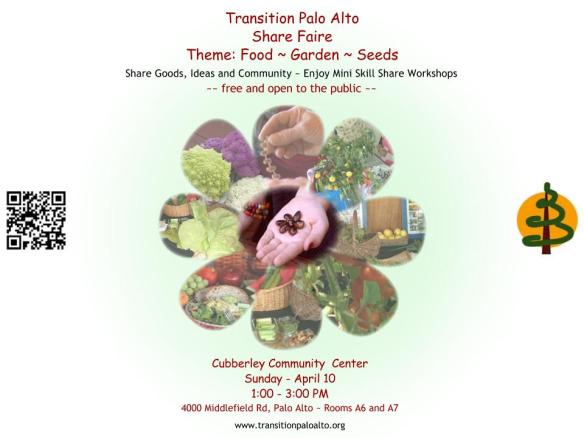
Join us for the Spring Share Faire, where we share skills with small 30-minute classes, goods ranging from garden produce to household items, and stories. Our theme this Faire is Food and Garden, so expect refreshments, and bring family and friends!
We’ll be back at Cubberley Community Center, using their classrooms for protection from a possible, and hoped for, re-visit from El Nino. So, mark your calendars for April 10, from 1:00 to 3:00 PM and plan to come join us.
Teachers wanted! We want to learn the skills you have! If you want to teach a 30-minute skill-share class aboutFood or Garden topics reply to this e-mail.
The focus for April at Transition Palo Alto is Seeds! We have endorsed AB 1810, the California Seed Exchange Democracy Act (learn more and sign up for alerts here), we’re partnering with local organizations on April 17 forSeed Day in Cupertino (more info soon!), and our Fourth Friday film on April 22 will be Open Sesame: The Story of Seeds. So – seed oriented skill shares are particularly desired!
Volunteers wanted! We continue to have great volunteers at our Share Faires. We’ll be glad to have help setting up and cleaning up, greeting people and managing goods, and more. You can sign up on line here.
And please print out and post our wonderful event flyer – courtesy of Herb Moore – to locations where you might find people who are interested in our event.
=============
You can follow for updates on Facebook, our Meetup group, and on Twitter (@patransition). Details on all Share Faires are here.
=============
Got books? Got books you don’t want? Want books? Our friends at FOPAL hold a giant used book sale every 2nd Saturday and Sunday of the month at Cubberley Community Center (4000 Middlefield Rd, Palo Alto). In April, it will take place on the 9th and 10th – Hey, it’ll be going on at the same time as the Share Faire, so you get a two-fer!
==============
We want to thank Zero Waste Palo Alto for being an event sponsor! Reduce, Reuse, Recycle, Compost!
New Economy Transition – what’s up for the March meeting
New Economy Transition (NET) is the group that formed after Marco Vangelisti’s Essential Knowledge for Transition talks last fall on money, economy, and investment. The group has started to look at changes that each of us can make in our own lives, as well as other efforts to move away from business-as-usual.
This is the line-up for the March 20 meeting. All are welcome, whether you’ve attended before or not!
- Dave Thompson will lead two sessions:
- My Intention with Spending: Collectively, as a consumers we have a lot of power in shaping our economy. Yet, there are powerful forces at play that often shape our spending habits. In this workshop we will explore the “marketplace” and examine our spending habits. We will have the opportunity to look at pathways to align our spending habits with values of equity and environmental stewardship.
- Banking with Intention: This brief workshop will examine ways in which we can move money out of big banks. We will look at the pros and cons of different financial institutions along with local resources to help participants in their pursuit of aligning their financial life with their values.
- Barbara Weinstein and Eitan Fenson will report briefly on Marco’s all day workshop, which they attended March 12.
March 20, 2-4pm
Unitarian Universalist Fellowship of Redwood City
2124 Brewster, Redwood City
March Fourth Friday – The Yes Men Are Revolting
Fourth Friday/Films of Vision and Hope

For 20 years, the Yes Men have staged outrageous and hilarious hoaxes to draw international attention to corporate crimes against humanity and the environment. Armed with thrift-store suits and a lack of shame, these iconoclasts lie their way into business and government events to expose the dangers of greed.
Now in their 40s, their mid-life crises are threatening to drive them out of activism – even as they prepare to take on the biggest challenge: climate change. The Yes Men Are Revolting is as much a character study as it is an entertaining depiction of their latest interventions. Revealing the real people behind the ruses, at its heart lies a hopeful message about fighting for change. Watch the trailer…
Friday March 25, 7:15pm gather – film starts promptly at 7:30 – discussion follows
Fireside Room, Palo Alto Unitarian Universalist Church
505 E. Charleston Avenue, Palo Alto
Transitioners in Action – Thomas Atwood
Too many people in our society are marginalized, and none more than immigrants, who come to U.S. to escape violence and poverty, looking only for a way to provide for their families – and too often find that the deck is stacked against them. Transitioner Thomas Atwood is working hard to change that. He started Fools Mission a few years ago to bring people who have access to wealth and privilege together with people who don’t, providing friendship, companionship, support, and a community that bridges the cultural, social, and economic divide.
Thomas is also passionate about educating people about the injustices of our economic system. Last fall, he helped organize Marco Vangelisti’s talks on economy, money, and investment, and and since has helped kick off the New Economy Transtition group, which is exploring alternatives to the economic status quo, including what each of us can do as individuals to change our relationship with the economic system.

Thomas writes about Fools Mission….
Fools Mission is a consciousness-raising ministry of supportive companionship on the San Francisco Peninsula. Our core mission is to build solidarity, friendship, and community between people who have access to wealth and privilege and those who don’t—and we accomplish our purpose by engaging in witness, accompaniment, advocacy, education, and the arts. Fools Mission is based on a simple premise—that we won’t address climate change or achieve social justice until people from all walks of life are sharing meals, swapping stories, and reflecting together in a way that acknowledges our interconnectedness with each other and the Earth.
What Do We Do?
Fools accompany one another through life’s ups and downs. We learn together how life works for people who live on the margins of our culture by accompanying other fools during their encounters with bureaucracy and “the system.” We find ourselves seeing and hearing the world with different eyes and ears at school district meetings, medical appointments, human service agencies, disability offices, police stations, and court hearings. Fools prefer first-hand experience to second-hand judgments, so each fool serves as both a teacher and a student.
How is the Way of the Fool Different?
Recognizing that many existing social service agencies already focus on housing, education, and jobs, fools offer alternative approaches to “provider/client” models. Though we enthusiastically build partnerships with nonprofit agencies, Fools Mission has no patrons or clients. A power differential is built into this type of relationship that encourages a false sense of superiority and leaves little room for personal empowerment. Only when low-income and underprivileged families are mentally, emotionally, physically, and spiritually able to cope with the challenges of their everyday lives—and there are sufficient resources to address long-standing community needs—are goals of food, housing, and education security attainable.
That’s why Fools Mission finds its way in the healing power of relationship: direct experiences of other people’s lives, raising class consciousness, and fostering empathy. The magic begins as we become aware of our reflexive tendencies to judge or invalidate others, and spend less time trying to separate the worthy from the unworthy. An entirely new world opens up to us as we stretch our emotional range. When something is happy, we laugh; when it’s tragic, we cry. The calculated emotional restraint of our data-driven culture begins to wither away in favor of the human capacity to feel deeply; to hear and be heard; to see and be seen.
Programs
Our programs focus on education and the arts, including regular tutoring events for children and parents, ritual and celebration, housing workshops, book groups, classes on discipline in public schools, immigrant education, theatre improvisation, and music. As we confront the socially-constructed boundaries of identity that separate us, we learn the importance of identity in our lives: language, culture, nationality, ethnicity, gender, education, ability, race, and class. As we learn more about the identities that we bring to the table, advocate for others, and reflect in community on the meaning of our activities, we discover our common humanity.
The Identity of the Fool
Throughout history, trickster characters in myth, literature, and art have served to challenge and disrupt decaying or paralyzed cultures. Beginning with the trickster stories of indigenous tribes, we also find the fool in West African divination gods, Greek and Indian mythology, abolitionists, artists, poets, and musicians. The fool appears in the first card in the Tarot deck and the medieval court revealed by Shakespeare—always ready to live in the moment, leave room for randomness and chance, and speak truth to power. Contemporary fools such as Jon Stewart and Stephen Colbert are among the most popular manifestations of the archetype today. As cultural critic Lewis Hyde points out in his classic analysis of the lineage of the fool, Trickster Makes This World: Mischief, Myth, and Art: “All of our ideas about property and theft are based on assumptions about how the world is divided up.”
For Fools Mission, embracing the identity of the fool is a way of introducing a level playing field as people begin to socialize across boundaries of social class. It’s hard to feel superior (or inferior) when everyone in the room is wearing a foolscap or clown nose. The fool acknowledges the importance of humility in a world that too often fails to recognize the limitations of human knowledge. As we learn to listen more deeply and reflect on the interplay of systems and stages of consciousness, we approach a stance of radical compassion and unitive consciousness that the world is hungry for.
Though we are a non-denominational lay ministry that requires no affiliation with religious institutions or beliefs, most people recognize the spiritual nature of our activities. Many of our participants are Christians and Jews, and the Judeo-Christian tradition places special emphasis on the role of the fool. As Paul the Apostle (a Pharisaic Jew) said, “Don’t be deceived. If any of you thinks that you are wise in the eyes of this age, you will have to become foolish before you can become truly wise. Because what this world counts as wisdom is folly in the eyes of God.”
Find out more about Fools Mission at http://www.foolsmission.org/about-us.